Types of Paving and Where Each One Works
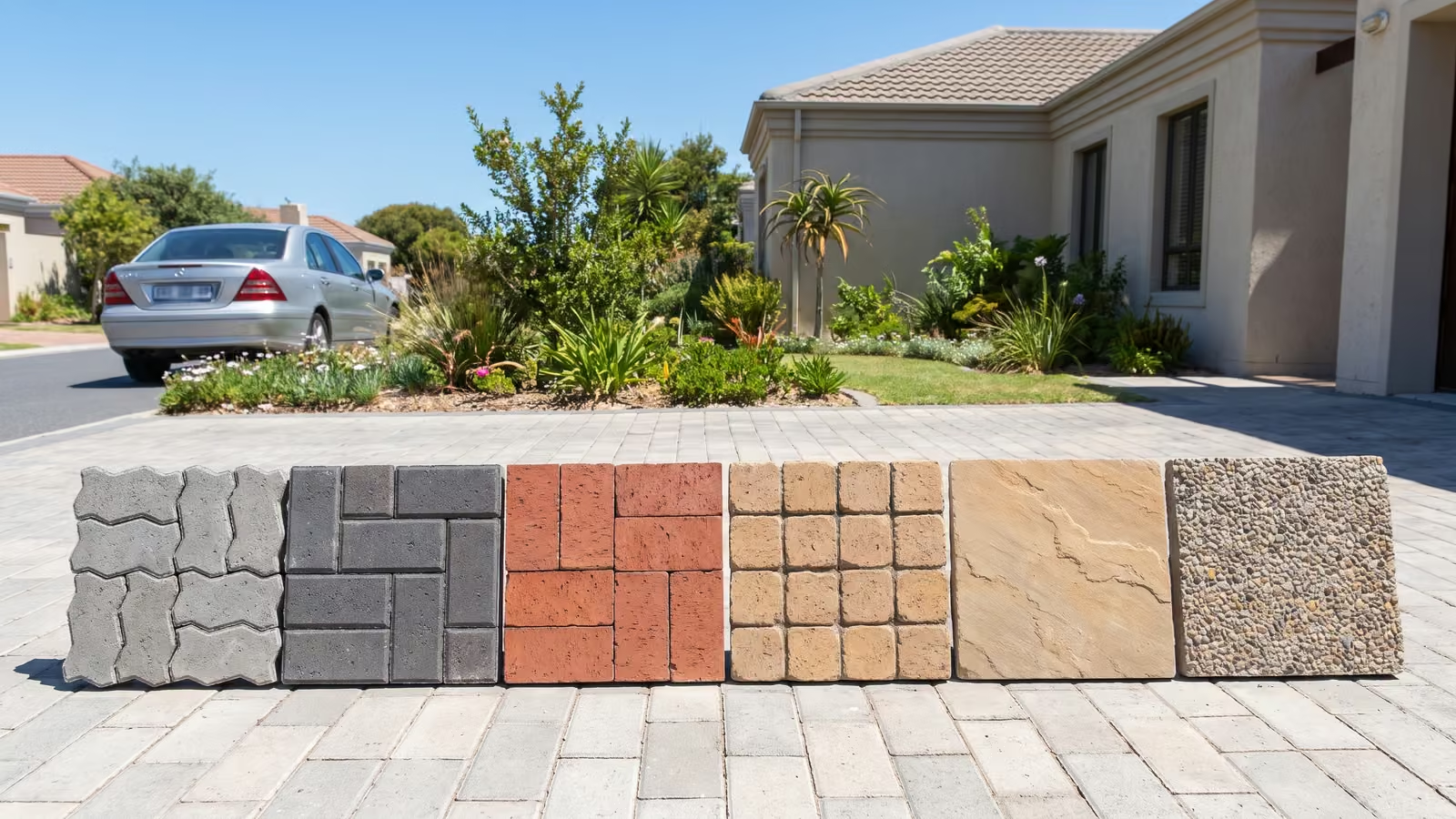
This guide compares the types of paving found on South African homes: concrete and clay pavers, cast-stone cobbles and flagstones, natural stone, permeable paving and tar. The City of Cape Town's roads standard says the two types of block paving allowed on its roads are concrete and clay. Its paver table points concrete pavers to SANS 1058, in classes 30/2.0 and 40/2.6, and clay pavers to SANS 1575. Corobrik says all its clay pavers are made in accordance with SANS 1575 for burnt clay paving units.
- City of Cape Town roads: concrete pavers to SANS 1058, classes 30/2.0 and 40/2.6
- Corobrik clay pavers: SANS 1575, classes PA and PB
- Bosun's permeable system: 80 mm pavers, single-size stone in the joints
Get a paving quote
Choose the job, the size and the area, and leave a number. Paving for Africa phones or WhatsApps you back.
Or call / WhatsApp 062 397 4233 · open WhatsApp
Types of paving compared
SmartStone, a South African maker of wet-cast paving, publishes a side-by-side look at five common paving surfaces. The table condenses it. Read it as one maker's view, since SmartStone sells one of the five.
| Type | Where it scores | What to watch |
|---|---|---|
| Dry-cast concrete pavers | Lowest cost of the segmented materials, accurate sizes, easy to install | Surface weathering in the long term |
| Wet-cast concrete (cast stone) | Various shapes, textures and sizes that copy natural stone | Obvious weathering of the surface in the long term |
| Natural stone | Natural colours and textures | Lack of long-term consistency, limited dimensional accuracy |
| Clay pavers | Natural appearance with good colour fastness | Spalling or chipping of edges, white efflorescence |
| Tar (asphalt) | Low initial cost of installation, smooth driving surface | Heavy vehicles turning sharply and slowly |
Concrete pavers: classes and thickness
The Concrete Society of Southern Africa lists thicknesses of 50, 60, 80, 100 and 120 mm. Class 30/2.0 pavers average 2.0 MPa in a tensile splitting test, and class 40/2.6 pavers average 2.6 MPa. The same leaflet says tests have shown that 25 MPa pavers are usually structurally adequate.
The CMA's Book 3 says Class 25 should be specified for most uses, and Class 35, at least 35 MPa on average, where exceptional loads are expected.
The City of Cape Town's roads standard asks for class 30/2.0 concrete pavers at 60 or 80 mm, class 40/2.6 at 80 mm, or class PA clay pavers at 60 or 73 mm. For domestic use the CMA says 50 to 60 mm blocks are generally adequate.
Bosun describes interlocking pavers as units that interlock mechanically because of their zig-zag shape. It says most makers offer them in 60 mm and 80 mm, and recommends laying them in herringbone with solid edge restraints like concrete kerbs.
Clay pavers
Corobrik makes its clay pavers in accordance with SANS 1575, the standard for burnt clay paving units. Corobrik lists a nominal modulus of rupture of 4 MPa for class PA, noting that this requirement does not apply to units shorter than 80 mm. The Clay Brick Association's guide says class PB units have uniform arrises that are not chamfered. It sets a nominal thickness of at least 50 mm for any clay paving unit.
Corobrik says its clay pavers are made from natural clay, with no pigments added. It says the natural colours of clay pavers do not fade over time.
What each maker says about fading and efflorescence
The statements below are attributed one by one, with the material each one covers.
According to Bosun, sun, rain and traffic usually make ordinary oxide-coloured concrete paving lose colour over time. Revelstone says its colour cannot fade over time, because its products are made with imported iron oxides. Bosun developed its Colourfast range for that reason, and says it derives its colour from stones instead of oxides.
SmartStone's comparison lists clay pavers as very susceptible to white efflorescence. The Clay Brick Association says salt attack and efflorescence are problems with some clay paving, and that a coarse bedding sand, which breaks the capillary rise, is essential. On concrete pavers, the CMA says efflorescence is mostly a temporary effect and purely superficial.
Cobbles, flagstones and crazy paving
Cobbles are small units laid tight together. Revelstone's Kent Cobble at 110 x 110 x 50 mm lays at 81 to the square metre. Flagstones are thin and large: Bosun's are 35 mm thick, at 400 x 400 mm or 200 x 400 mm.
Revelstone draws the line between a tile and a paver by thickness. Revelstone's tiles of 15 to 25 mm need a concrete base to be glued to, while its pavers of 40 to 55 mm can be laid directly onto a well-prepared compacted sub-base. Revelstone describes its Ravine crazy paving as completely irregular shapes and sizes that capture the character of original quarried slate.
Permeable paving is a different build
Bosun's permeable system uses 80 mm pavers so that there is enough rotational interlock with the single-size stone in the joints. Its base is single-size stone too, where ordinary paving sits on a material like G5 that compacts well. Bosun lists, as a common mistake, pavers grouted with sand and installed on a sand bed, and says such a system will clog very quickly.
Joint filling matters on any type. Bosun does not recommend cement grouting, because it stains and breaks and pops out over time.
Choosing a type for each part of the property
For driveways, the Clay Brick Association recommends herringbone, at 45 or 90 degrees, for areas with wheeled traffic. SmartStone points patios to large, flat pavers, because it says cobblestones may leave tables and chairs unsteady. Texture is a trade-off: the CMA says smoother blocks look better while rougher blocks give better skid resistance.
Paving for Africa is one of the paving contractors in Cape Town. It installs brick and cement paving, tar surfacing and exposed aggregate concrete, and does not sell pavers. Once the type is settled, the paving patterns guide covers how the units go together and the paving design ideas guide covers borders and colour blends.
Paving type questions
Are clay bricks better than concrete pavers?
Yes, for colour that lasts. Corobrik says the natural colours of clay pavers do not fade over time. Bosun says oxide-coloured concrete paving usually loses colour with time. The City of Cape Town accepts both concrete and clay block paving on its roads.
Do concrete pavers fade in the sun?
Yes, ordinary oxide-coloured ones usually do. According to Bosun, sun, rain and traffic usually make ordinary oxide-coloured concrete paving lose colour over time. Revelstone says its colour cannot fade, as it uses imported iron oxides. Bosun sells its stone-coloured Ash, Kalahari, Ivory, Basalt and Ebony as fade resistant.
What is the difference between a tile and a paver?
Thickness and base. Revelstone's tiles are 15 to 25 mm and need a concrete base to be glued to. Its pavers are 40 to 55 mm and can be laid directly onto a well-prepared compacted sub-base.
What is the cheapest form of paving?
SmartStone's comparison gives dry-cast concrete the lowest cost of the segmented materials and tar a low initial cost of installation. Paving for Africa quotes cement paving supplied and laid per job.
Tar, half brick or interlock: which is better for a driveway?
SmartStone lists tar as not suited to heavy vehicles turning sharply and slowly. Bosun's Bevel Bond is a 200 x 100 mm paver, and at 50 mm thick it lays at 50 per m². Its 60 mm interlocker lays at the same 50 per m². Bosun recommends herringbone with solid edge restraints for interlockers.