
Drainage for a Driveway: Falls, Channels and Cape Town Rules
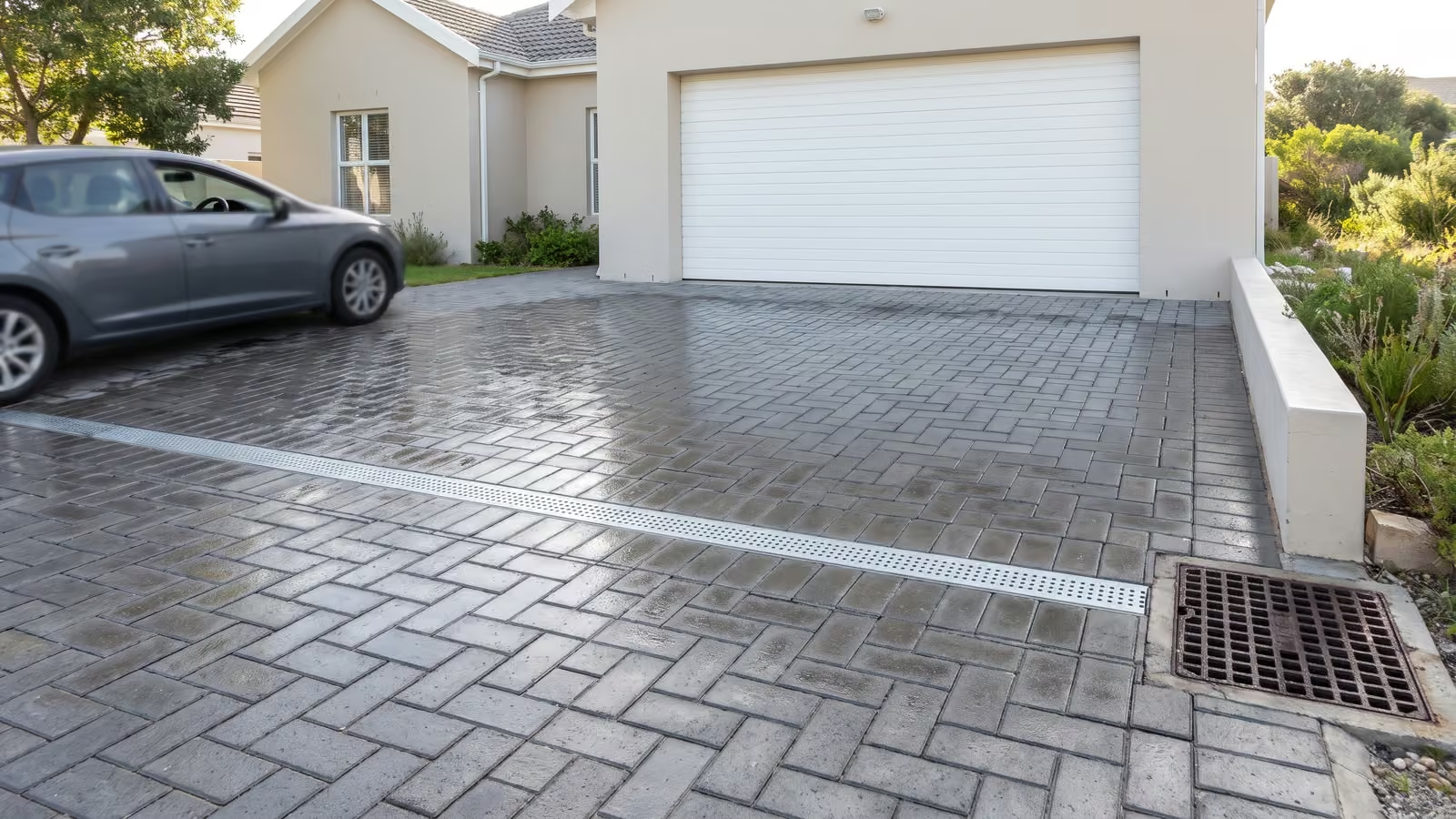
Drainage for a driveway starts with the fall. For concrete block paving, the CMA says a minimum fall of 2% in any direction is generally required, and that paving should be laid 5 to 10 mm higher than the stormwater structures or channels next to it. On a slope, the CMA warns that water getting through the paving can collect in the bedding sand at the lowest point. In Cape Town, the City says stormwater from a property must be led to the street or into the City's stormwater system, never into the sewer network.
- Concrete block paving: minimum fall of 2% generally required (CMA)
- Pave 5 to 10 mm proud of stormwater structures and channels (CMA)
- Stormwater goes to the street, not the sewer (City of Cape Town)
Get a paving quote
Choose the job, the size and the area, and leave a number. Paving for Africa phones or WhatsApps you back.
Or call / WhatsApp 062 397 4233 · open WhatsApp
Why drainage for a driveway decides how long it lasts
The CMA's design manual blames most pavement failures on water getting into the layers under the surface. It calls for care with surface drainage, and with subsoil drainage where needed, and says the paving needs adequate falls along its length and no dips if water is not to pond.
The CMA says jointing sand may be lost in the first few months, and that the problem is greatly reduced as the joints become clogged with road detritus. It says this plugging is usually well established after about three months of pavement usage. Where a high water table exists, it says subsoil drainage should be installed.
Falls: the published numbers
Each figure below comes from a different document, written for a different layer or part of the job.
| Guidance | Fall |
|---|---|
| CMA design manual, concrete block paving surface | A minimum of 2% in any direction, generally required |
| CMA homeowner guide, site preparation | A minimum slope of 1 in 50 in one direction and 1 in 100 in the other, sloping away from the garage floor |
| CMA specification, top of the subbase | At least 1% along the length and at least 2% across |
| City of Cape Town, driveway crossing | At least 1% cross slope for surface drainage, applying past the back of the footway or past the required 1.5 m wide strip |
| Tobermore (UK maker), slab paving | A minimum longitudinal fall of 1.25% (1:80) and a cross-fall of 2.5% (1:40) for slab paving |
The fall belongs in the subbase. The CMA's design manual wants a thin bedding sand layer, and warns that using it to fill hollows in the subbase leads to settlement later.
Channels, grates and downpipes
The CMA says paving should be laid proud of stormwater structures or channels, 5 to 10 mm higher.
Downpipes are a weak spot. The CMA's homeowner guide says to stabilise jointing sand only on steep slopes over 1 in 20, around downpipes and along roof overhangs with no gutters. For that, it says to use bentonite or proprietary sealers, and not cement.
Where the water is allowed to go in Cape Town
Cape Town's rules keep stormwater and sewage apart.
- The City says rainwater leaving a property belongs in the street or the City's stormwater system, not in the sewer network.
- The City's Wastewater and Industrial Effluent By-law bars an owner from letting groundwater or stormwater into a private sewer installation on the premises, unless the Council gives written consent and written conditions.
- A City media release in July 2025 named rainwater from roofs, gutters or paved surfaces directed into sewer drains as a cause of sewer overflows, and suggested letting it soak into unpaved ground or garden areas.
The City's Stormwater Management By-law of 2005 sets further duties. The points below follow its wording.
- Section 3 bars anyone from putting anything other than stormwater into the stormwater system, unless the Council consents in writing, and then subject to any conditions it imposes.
- Section 8 makes an owner whose property has a private stormwater system keep it working effectively at the owner's own cost. That duty falls away to the extent that the Council has taken it on, through a formal maintenance agreement or a servitude condition.
- Section 10 lets the Council, by written notice, require an owner to keep stormwater on the property, or to lay a drain pipe or gutter at the owner's cost to a suitable place the Council points out.
- By written notice, the Council can also require an owner to let the owner of higher-lying land lay a stormwater pipe or gutter across the lower property, to drain concentrated stormwater.
Permeable paving
The City says it follows the principles of sustainable urban drainage systems (SUDS), which manage drainage the way nature handles stormwater.
Bosun's permeable system uses 80 mm pavers, single-size stone in the joints and a single-size stone base. Bosun lists, as a common mistake, pavers grouted with sand and installed on a sand bed, and says such a system will clog very quickly.
The paved drive itself is covered on our page on driveway paving in Cape Town. Surfaces, borders and steep-plot solutions are in the driveway ideas guide.
Driveway drainage questions
Is driveway drainage a legal requirement in Cape Town?
No, not as a drain on every driveway. The Stormwater Management By-law sets duties rather than a drain for each driveway. Section 8 says owners of property with private stormwater systems shall, at own cost, keep them functioning effectively, unless the Council has accepted that responsibility in a maintenance agreement or servitude condition. Section 10 lets the Council, by written notice, direct an owner to retain stormwater on the property or to lay a drain pipe or gutter to a place it indicates.
Can I connect driveway drainage to the main drain?
No, not to the sewer. The City of Cape Town says stormwater from your property must go to the street or into its stormwater system, and not into the sewer network.
What happens if I don't install driveway drainage?
The CMA blames most pavement failures on water getting into the layers under the surface. On a slope, it says water getting through the paving can collect in the bedding sand at the lowest point.
Does the City of Cape Town require permeable paving?
The Stormwater Management By-law does not name permeable paving. Section 10 does let the Council, by written notice, direct an owner to retain stormwater on the property. Separately, the City says it follows the principles of sustainable urban drainage systems.