Tar Surfacing in Cape Town
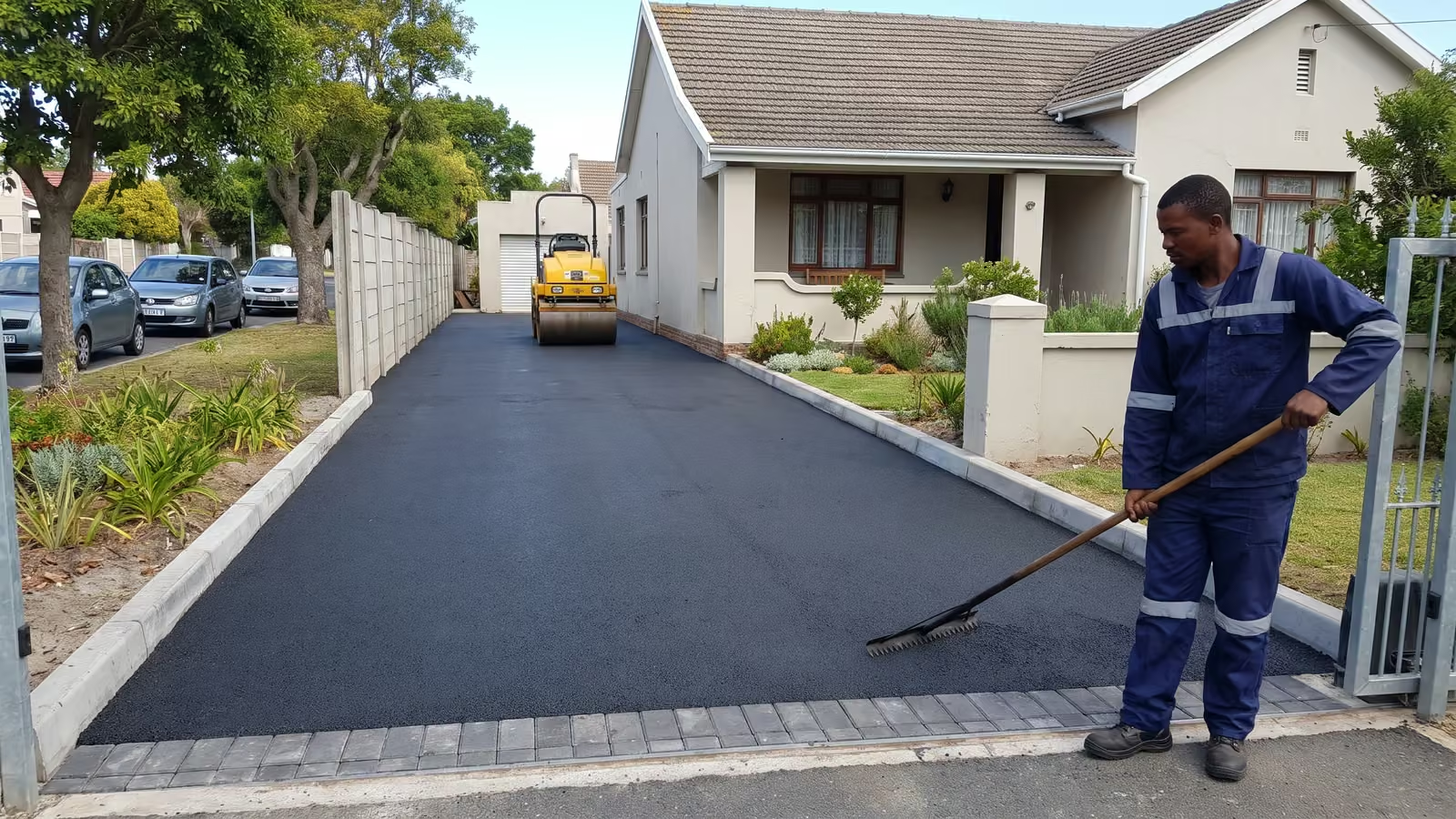
Tar surfacing in Cape Town is quoted per job, as fewer than three Cape Town installers publish a price. A new tar driveway needs a base as well: the City of Cape Town's light-duty residential crossing uses 30 mm of asphalt on 150 mm of G5 and 150 mm of G7, an excavation of 330 mm. Paving for Africa lays hot-mix asphalt for driveways and parking areas.
- Quoted per job
- City crossing: 30 mm asphalt on 150 mm G5
- Sabita recommends tack coats for wearing courses
- Hot-mix asphalt for driveways and parking areas
Get a tar quote
Choose the job, the size and the area, and leave a number. Paving for Africa phones or WhatsApps you back.
Or call / WhatsApp 062 397 4233 · open WhatsApp
What a tar driveway is made of
"Tar" on a driveway usually means hot-mix asphalt: crushed stone bound with bitumen, mixed hot and rolled into a dense layer. Sabita says 20 to 30 mm thin asphalt has been widely used on low-speed roads in residential areas.
| Layer | City of Cape Town light-duty residential crossing |
|---|---|
| Asphalt surface | 30 mm (40 mm medium duty, 50 mm heavy) |
| Base | 150 mm G5, compacted to 98% of maximum dry density (Mod AASHTO) |
| Subgrade | 150 mm G7 |
| Total excavation | 330 mm |
The City wants the asphalt compacted to 93% of its maximum voidless (Rice) density.
Tar surfacing in Cape Town: Sabita's laying guidance
The points below are selected recommendations from Sabita's manuals, not a full procedure.
- Prime. Sabita says a properly applied and well cured prime coat acts as a temporary protection from rain.
- Tack. Sabita recommends tack coats for wearing courses at all times.
- Lay. Sabita says asphalt made with 60/70 pen bitumen comes out behind the paver at about 140 °C, and about 10 °C lower with 80/100 pen bitumen.
- Hand work. Hand-laid areas cool fast, so Sabita suggests increasing the mat thickness there to 40 mm.
Tar surfacing in cold, wet or windy weather
Thin asphalt loses heat fast. Sabita's example is a 25 mm layer laid at 13 °C with an 18 °C base and a 20 km/h wind, which leaves only 7 minutes to compact it. In conditions like that, Sabita says paving should not be permitted.
Asphalt or paving for the same driveway
| Item | Tar (asphalt) | Paving |
|---|---|---|
| Price | Quoted per job | Quoted per job for a driveway |
| City light-duty residential crossing | 30 mm asphalt on 150 mm G5 and 150 mm G7 | 60 or 80 mm pavers on 25 mm uncompacted sand, 150 mm C4 and 150 mm G7 |
For the paving side, see driveway paving in Cape Town.
How long tar lasts and how it ages
Sabita says thin asphalt in residential areas provides a more durable surface than a chip seal, in many cases lasting 20 to 30 years. That figure is for residential streets, not a promise for any one driveway. Sabita says hardening due to oxidation is irreversible. In thin layers exposed to a severe environment, hardening can make the surface brittle, leading to cracking, fretting and stone loss, according to Sabita. A fog spray, a light application of diluted bitumen emulsion, is a maintenance treatment for an existing bituminous surfacing.
Tar across the verge
The City of Cape Town lists asphalt among its approved materials for driveway crossings. A new or altered crossing needs a City Miscellaneous Permit, and no work may start until it is signed. Paving for Africa lays tar alongside its other paving work across Cape Town.
Tar surfacing questions
How much does tar surfacing cost per m² in Cape Town?
Paving for Africa quotes tar surfacing per job, as fewer than three Cape Town installers publish a price.
How thick should a tar driveway be?
The City of Cape Town uses 30 mm of asphalt for a light-duty residential crossing, on 150 mm of G5 base. For asphalt laid by hand, Sabita suggests 40 mm.
How long does a tar driveway last?
Sabita's figure is for thin asphalt on residential streets: in many cases 20 to 30 years. It is not a figure for any one driveway.
Can tar be laid in winter?
No, not in cold, windy weather. Sabita's example of a 25 mm layer at 13 °C air, an 18 °C base and a 20 km/h wind leaves only 7 minutes to compact it, and Sabita says paving should not be permitted then.
Why is my tar driveway cracking?
Bitumen hardens as it oxidises. In thin layers where exposure is severe, Sabita says that hardening can lead to cracking, fretting and stone loss.