
How to Kill Weeds on Pavers
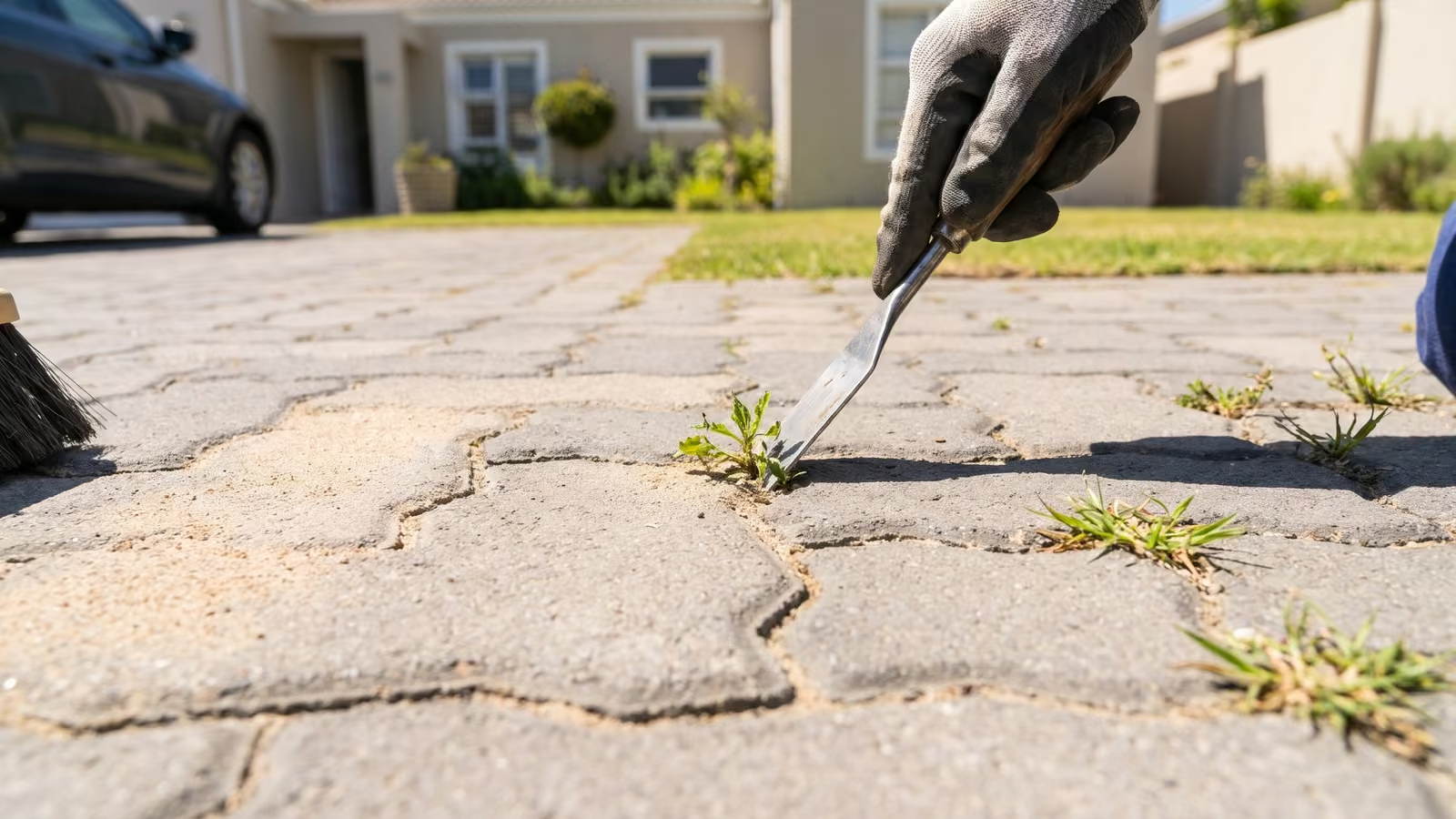
To kill weeds on pavers, the CMA's homeowner guide gives two options: remove them carefully by hand, or spray the paving surface with a proprietary weed killer. Most paving weeds start from seed. On large paved areas, the CMA puts about ninety per cent of plant growth down to seeds blown in by the wind that sprout in the jointing sand. For choosing a herbicide, it says expert advice should be sought from the Department of Agriculture and from reputable manufacturers.
- About ninety per cent of growth in large paved areas is from wind-blown seed (CMA)
- Hand removal or a proprietary weed killer (CMA homeowner guide)
- Plastic sheeting under paving does not stop weeds (CMA)
Get a paving quote
Choose the job, the size and the area, and leave a number. Paving for Africa phones or WhatsApps you back.
Or call / WhatsApp 062 397 4233 · open WhatsApp
Where weeds in paving come from
Weeds in paving mostly grow from seed that lands on top. The CMA's homeowner guide puts it plainly: seeds drop into joints, germinate after rain.
The exception is a creeping grass. The CMA's design manual singles out Kikuyu grass coming up from under the blocks. For that case it allows a suitable herbicide, either mixed into the jointing sand or sprayed over the finished paving. It warns that careless use of poisons can do extensive damage to cultivated areas.
Plastic under the paving is the wrong fix. The CMA does not recommend plastic sheeting under paving blocks to stop the growth of wind-blown seed in the joints. Its homeowner guide says plastic under the bedding sand badly affects particle interlock and does not stop weeds from growing.
Ways to kill weeds on pavers, compared
Each method below is set against what a university extension service, a horticultural body or a paving guideline says about it.
| Method | Finding |
|---|---|
| Hand weeding with a paving knife | The Royal Horticultural Society says to run a block paving knife along the cracks to sever roots, and that repeated removal of top growth will weaken deep-rooted weeds and may eventually kill them |
| Wire-bristle paving brush | The RHS uses one to scrub mosses, weed seedlings and debris from cracks and paving joints |
| Flame weeder | The RHS rates weed burners not ideal: they bring a fire risk, need fuel or power, and do little against deep-rooted perennials |
| Household vinegar | Montana State University puts household vinegar at generally 5% acetic acid against 20% or 30% in some herbicidal products, and says acetic acid only harms the plant parts it touches |
| Vinegar, Epsom salt and dish soap | An Oregon State University extension author tried the mix on a stand of Canada thistle in a pasture, and the thistle came back the next year as strong as ever |
| Stabilised (polymeric) joint sand | The CMHA paving guideline says joint stabilisation materials reduce the potential for weeds in the joints |
What vinegar can and cannot do
Montana State says acetic acid acts as a contact herbicide and does not move within the plant to the roots. It says smaller and younger weeds are generally more susceptible, with seedlings at the two- to four-leaf stage ideal because all their leaves can be reached by the spray.
It says a plant that vinegar does not kill outright can grow back. Perennials are unlikely to be controlled, because they can regrow from the roots after their tops die. Acetic acid has no residual activity in the soil, so it gives no control beyond its first contact.
Montana State warns that 20% and 30% acetic acid products are strong acids and that applicators should wear personal protective equipment.
Choosing and using a weedkiller
The CMA's homeowner guide allows a proprietary weed killer sprayed over the paving surface. Its design manual says expert advice on the choice of herbicides should be sought from the Department of Agriculture and from reputable manufacturers.
The RHS says it does not back weedkillers and recommends other ways of controlling weeds.
Keeping the joints full
The joint sand is where most paving weeds root, so its upkeep is part of weed control. A photo caption on the RHS page says repointing paving to fill in gaps will reduce weed growth.
- The CMA's design manual says joints in concrete block paving should be topped up when required, typically three months after construction.
- Bosun recommends replenishing jointing material a month after installation and twice a year after that, until the joints are stabilised.
- For its SMARTSAND polymeric sand, Techniseal says the sand must dry completely before being exposed to rain, 24 hours minimum, and longer in cold or humid weather or in joints wider than 13 mm. It gives a minimum joint depth of 4 cm and says to use it only on sand-set pavers.
For paving cleaning in Cape Town, the mean of three Cape Town cleaners' published prices is about R45 per m². Paving for Africa cleans and seals paving. Oil marks and green growth are covered in separate guides, on oil stains on paving and on moss and algae on paving.
Weeds in paving questions
Which weedkiller works best on paving?
The CMA does not name one. It says expert advice on the choice of herbicides should be sought from the Department of Agriculture and from reputable manufacturers, and warns that careless use of poisons can do extensive damage to cultivated areas.
Does vinegar kill weeds between pavers?
Yes, small young weeds, and it often leaves perennials to regrow. Montana State University says acetic acid only harms the plant parts it touches, and that perennials can regrow from the roots after their tops die. An Oregon State extension author found Canada thistle sprayed with a vinegar, Epsom salt and soap mix came back the next year.
What's the best way to remove weeds from paving joints?
The RHS runs a block paving knife along the cracks to sever roots and levers the weeds out with its hooked end. It says repeated removal of top growth will weaken deep-rooted weeds and may eventually kill them. The CMA says joints in concrete block paving should be topped up when required.
Should I put plastic under paving to stop weeds?
No. The CMA does not recommend plastic sheeting under paving blocks to stop wind-blown seed growing in the joints, and its homeowner guide says plastic under the bedding sand does not stop weeds from growing.