
Driveway Ideas: Pavers, Cobbles, Grass Blocks and Slopes
Driveway ideas for a Cape Town home start with what the drive has to carry and how steep it is. For domestic use the CMA says 50 to 60 mm concrete blocks are generally adequate. Herringbone is the pattern the Clay Brick Association recommends for wheeled traffic. At the street, the City of Cape Town caps the change in grade from the carriageway crossing to the private driveway at 17%. The same 17% cap applies to the change in grade between the road and the crossing, and the City says keeping to both limits means most vehicles will not scrape. It still asks designers to check clearance against a design vehicle.
- Domestic driveways: 50 to 60 mm concrete blocks (CMA)
- City of Cape Town: crossing-to-driveway grade change of no more than 17%
- Over 12.5% the City treats a driveway as steep
Get a paving quote
Choose the job, the size and the area, and leave a number. Paving for Africa phones or WhatsApps you back.
Or call / WhatsApp 062 397 4233 · open WhatsApp
Driveway ideas by surface
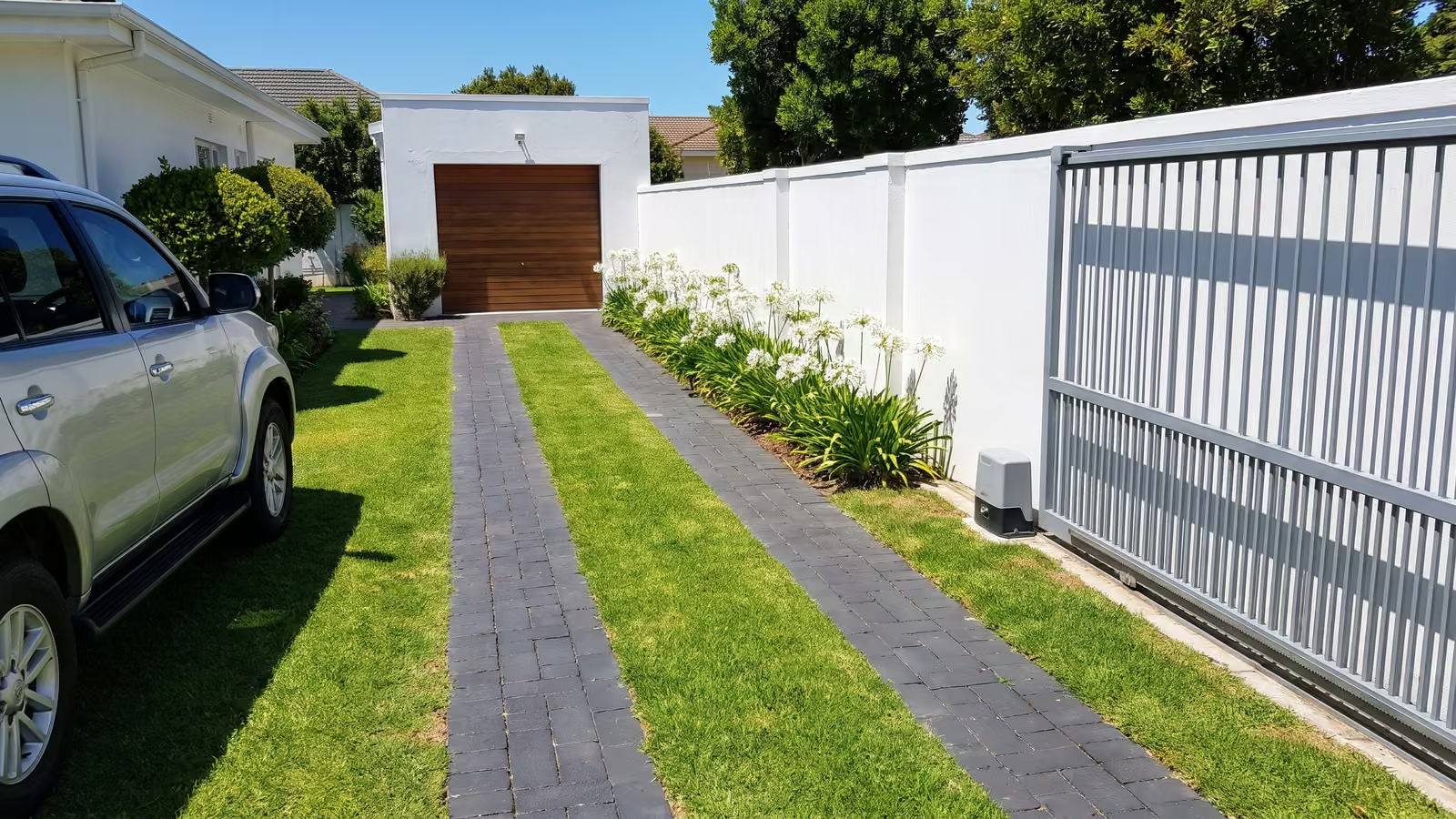
The surface sets the look and how the drive copes with turning wheels. The ideas below are the ones South African makers and the City's own standards describe.
| Idea | What it involves |
|---|---|
| Concrete pavers in herringbone | 50 to 60 mm blocks, which the CMA calls generally adequate for domestic use |
| Clay pavers | Class PA clay at 60 or 73 mm, the clay option the City lists for a residential crossing |
| Cobbles | SmartStone says smaller cobbles distribute weight better on a driveway and are less likely to crack |
| Grass blocks | Technicrete's Grassframe, a 400 x 600 mm block made in 90, 95 and 100 mm thicknesses |
| Permeable pavers | Bosun's permeable system: 80 mm pavers with single-size stone in the joints and a single-size stone base |
Thickness: 60 or 80 mm
For domestic use the CMA says 50 to 60 mm blocks are generally adequate. SmartStone says driveways require pavers at least 50 mm thick to withstand the weight of vehicles. It adds that smaller cobbles distribute weight better on a driveway and are less likely to crack.
The City of Cape Town's table for residential crossings lists 60 or 80 mm interlocking concrete pavers. Bosun makes its permeable pavers 80 mm thick to get enough rotational interlock with the single-size stone in the joints.
Driveway ideas for a steep plot
Sloping plots raise the same question: can a steep drive be paved? The City's standard designs crossings around a South African passenger vehicle with an undercarriage clearance of 130mm. It sets a minimum design gap of 50mm between that undercarriage and the surface.
The City treats a road or driveway with a proposed longitudinal grade over 12.5% as steep, to be investigated and assessed on its own merits. Where a gradient rules out asphalt, it says block or concrete paving is to be considered, anchored by beams at regular intervals.
- The CMA's Book 2 calls for an anchor beam at the bottom end of a steep block pavement and at intervals that depend on its length and gradient.
- The Clay Brick Association's guide to flexible clay paving on sloping driveways uses concrete beams across driveways longer than about 7 m, spaced at about 5 to 6 m.
- For those clay driveways it says pavers should be laid in a 45 degree herringbone pattern.
Work on the verge needs City permission. The City's RIM Wayleave Standards say a new or altered carriageway crossing needs no wayleave and instead forms part of a Miscellaneous Permit. That permit goes directly to the relevant RIM District Office.
Grass blocks
The US EPA describes grass pavers as lattices that allow grass or other vegetation to grow in the gaps. Bosun's Grass Block is 600 x 400 x 100 mm and lays at 4.2 per m². Its interlocking Buffalo Block leaves 20.5% of the installed area open.
The US Environmental Protection Agency says grass paving materials are most often used where lower traffic volumes would minimise damage to the vegetation, such as alleys, parking lots and trails. It says they may be best suited to climates with adequate summer moisture.
Borders, colour and the approach
At a residential crossing, the City lists the edge restraint as a brick stretcher on edge or a 150 x 75 mm E1 precast concrete edging. Bosun says darker colours disguise tyre marks more effectively, though the marks are still visible, and that cement staining is accentuated on darker colours like charcoal.
Street trees affect where a drive can go. For planting in the road reserve, the City's standard says trees should not be planted within 3 m from a driveway, and notes that its tree-planting rules are provided as guidelines.
The build of a paved drive, from the base up, is on our page on driveway paving in Cape Town. The falls and channels for a paved drive are set out in our guide to driveway drainage.
Driveway idea questions
Which paver is best for a steep driveway?
For clay, the Clay Brick Association's guide to sloping driveways says pavers should be laid in a 45 degree herringbone pattern, with concrete beams across driveways longer than about 7 m, spaced at about 5 to 6 m. For concrete blocks, the CMA's Book 2 calls for an anchor beam at the bottom end and at intervals that depend on length and gradient. The City of Cape Town assesses any driveway steeper than 12.5% on its own merits.
What is a good slope for a driveway?
The CMA says a minimum fall of 2% in any direction is generally required for concrete block paving. The City of Cape Town caps the change in grade at 17%, both from the road to the carriageway crossing and from the crossing to the private driveway, and says keeping to both means most vehicles will not scrape.
How thick should driveway pavers be?
For domestic use the CMA says 50 to 60 mm blocks are generally adequate. The City's table for residential crossings lists 60 or 80 mm interlocking concrete pavers.
How soon can I drive on new paving?
It depends on the product and the joint. Bosun says sand-grouted paving can be used immediately after grouting, and cement-grouted paving should not be trafficked for seven to ten days after installation. SmartStone says not to drive on a new SmartStone driveway for seven days.