
How to Remove Oil from Paving: Fresh Spills and Old Stains
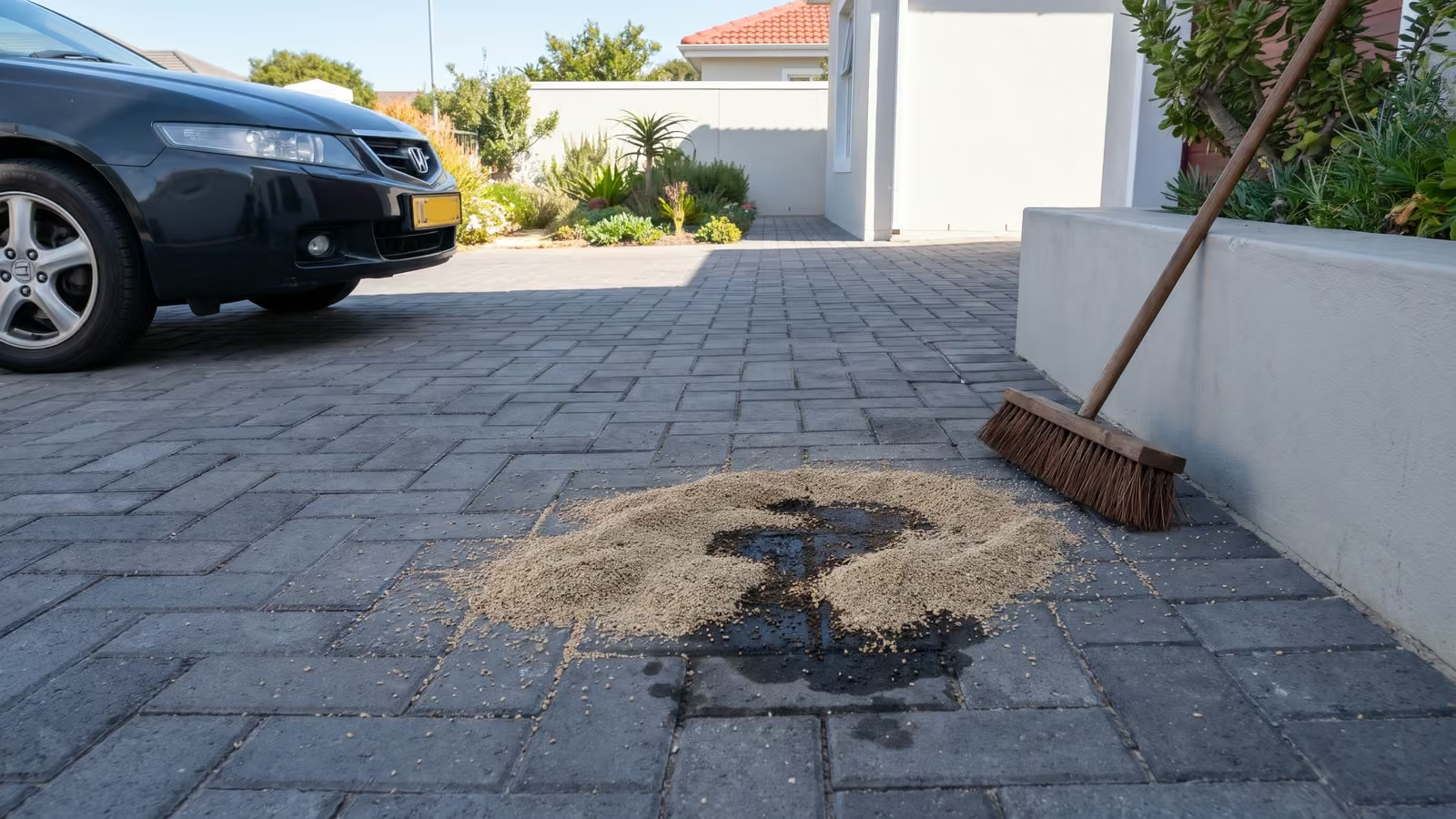
To remove oil from paving, act while it is fresh. The Concrete Institute says to stop the stain spreading by ringing it with a fine, dry material such as sand, cement, sawdust or cat litter. The CMA's homeowner guide says to cover oil stains with cat litter as soon as possible and brush the litter off once the oil is absorbed. For oil already in concrete, The Concrete Institute lists engine degreaser, high-foam washing powder and concentrated liquid detergent. On clay pavers, De Hoop Steenwerwe says the oil should not be wiped up, because wiping spreads it.
- Fresh oil: ring it with sand, cement, sawdust or cat litter (The Concrete Institute)
- Set-in oil on concrete: degreaser, high-foam washing powder or liquid detergent (The Concrete Institute)
- Test any cleaner on a small hidden area first (The Concrete Institute, De Hoop Steenwerwe)
Get a paving quote
Choose the job, the size and the area, and leave a number. Paving for Africa phones or WhatsApps you back.
Or call / WhatsApp 062 397 4233 · open WhatsApp
Fresh oil: contain it, then absorb it
The Concrete Institute says oil stains can be extremely difficult to remove from concrete because of their rapid ingress into the concrete. The CMA notes that concrete block paving itself is not affected by oil stains; the problem is the mark.
- Ring the spill with a fine, dry material such as sand, cement, sawdust or cat litter, so the stain cannot spread (The Concrete Institute).
- Mop up as much as possible with paper towels or cloths, blotting rather than wiping, then sprinkle the whole stain generously with the fine material, broom it back and forth, sweep it up and dispose of it (The Concrete Institute).
- For oil that has penetrated, the CMHA paving guideline says to cover the area with an oil absorbent such as kitty litter, and lists talc, fuller's earth and diatomaceous earth as alternatives. It says to leave it on the stain for a day, then sweep up.
Kärcher's South African guide gives a similar household answer: where no special cleaner is to hand, it uses cat litter or sawdust to soak up the oil, then sweeps it away.
How to remove oil from paving once it has set
The Concrete Institute says a stiff bristle brush is useful for thick surface oil deposits but inadequate for deposits that have already penetrated into the pores of the concrete. It has found three cleaners that work on oil stains: car engine degreaser, high-foam washing powder and concentrated liquid detergent.
The CMA's design manual says there are proprietary products designed specifically for removing oil stains from block paving. Where these are not available, it recommends scrubbing the paving with a strong detergent.
Before any of these, The Concrete Institute says to treat a small trial area in an inconspicuous place, to see the effect the cleaning method will have on the concrete. The CMHA guideline adds that deep-set oil stains often require repeated applications of the remover.
Clay pavers need different handling
De Hoop Steenwerwe, a clay brick maker, writes about clay pavers separately. It says oil does not soak readily into clay pavers, and that a spill should be lifted promptly with something absorbent, such as paper towels. It says the oil should not be wiped up, because that spreads the contamination on the surface of the paver. If its first cleaning method is unsuccessful, it says an emulsifying de-greaser should be employed.
For specific cleaning situations like oil stains, De Hoop suggests commercial cleaners available at masonry supply outlets, and says to always test any cleaner on a small hidden portion of the pavement first. It says pressure washers are not recommended on flexible base applications, because they tend to remove joint sand, which compromises interlock.
| Paver | Advice and source |
|---|---|
| Concrete pavers | Engine degreaser, high-foam washing powder or concentrated liquid detergent, after a trial on a hidden area (The Concrete Institute) |
| Concrete block paving | A proprietary oil-stain product, or scrubbing with a strong detergent (CMA) |
| Clay pavers | Remove the spill promptly with an absorbent material, blot rather than wipe, and use an emulsifying de-greaser if the first cleaning fails (De Hoop Steenwerwe) |
Sealing against oil: the bodies disagree
The CMHA guideline says sealers reduce the intrusion of stains, oils and dirt into the paver surface. The CMA's homeowner guide lists surface sealants as not recommended on block paving, citing high initial cost, abrasion that removes the sealer and regular maintenance.
For paving cleaning in Cape Town, the mean of three Cape Town cleaners' published prices is about R45 per m². Paving for Africa cleans and seals paving. Weeds and green growth have their own guides, on weeds between pavers and on moss and algae on paving.
Oil stain questions
How do I get oil stains out of paving?
Absorb fresh oil with a fine, dry material such as sand or cat litter, as The Concrete Institute and the CMA advise. On concrete, The Concrete Institute's cleaners are engine degreaser, high-foam washing powder and concentrated liquid detergent, tried first on a small hidden area.
Can I high-pressure clean sand-bedded clay paving?
No. De Hoop Steenwerwe says pressure washers are not recommended on flexible base applications, because they tend to remove joint sand, which compromises interlock.
Is bleach good for removing oil from paving?
No. Bleach is not on The Concrete Institute's list. Its list for oil is car engine degreaser, high-foam washing powder and concentrated liquid detergent.
How do I remove old oil stains from brick pavers?
On clay brick pavers, De Hoop Steenwerwe says to use an emulsifying de-greaser if its first cleaning method is unsuccessful, and to test any cleaner on a small hidden area first. On concrete, the CMHA guideline says deep-set oil stains often need repeated applications of the remover.
Does cat litter remove oil from paving?
On fresh spills, the CMA's homeowner guide says to cover oil stains with cat litter as soon as possible; the oil is absorbed and the litter is then brushed off.