Paving Contractors in Cape Town
Paving for Africa is one of the paving contractors in Cape Town, laying brick and cement paving, driveways, tar surfaces and exposed aggregate, and cleaning paving that has gone green. Cement paving and driveways are quoted per job. Cobble paving averages about R580 per m², the mean of three Cape Town installers checked in November 2026.
- Cape Town average for cobble paving: about R580 per m²
- Brick and cement paving, driveways, tar, exposed aggregate, cleaning and sealing
- Area served: Cape Town and surrounds
- Call or WhatsApp 062 397 4233
Ask for a paving quote
Choose the job, the size and the area, and leave a number. Paving for Africa phones or WhatsApps you back.
Or call / WhatsApp 062 397 4233 · open WhatsApp
What paving costs in Cape Town
The figures below are Cape Town averages, not a rate card. The cobble figure is the mean of three independent Cape Town installers, and the cleaning figure the mean of three Cape Town paving cleaners. Each is a price per square metre.
Cement paving supplied and laid is quoted per job, as fewer than three Cape Town installers publish an independent price. Driveway paving and tar surfacing are quoted per job for the same reason. Exposed aggregate and sealing are quoted per job as well, as Cape Town competitors do. The paving prices in Cape Town page breaks the averages down and has a calculator for your own square metres.
Paving services in Cape Town
Driveway paving
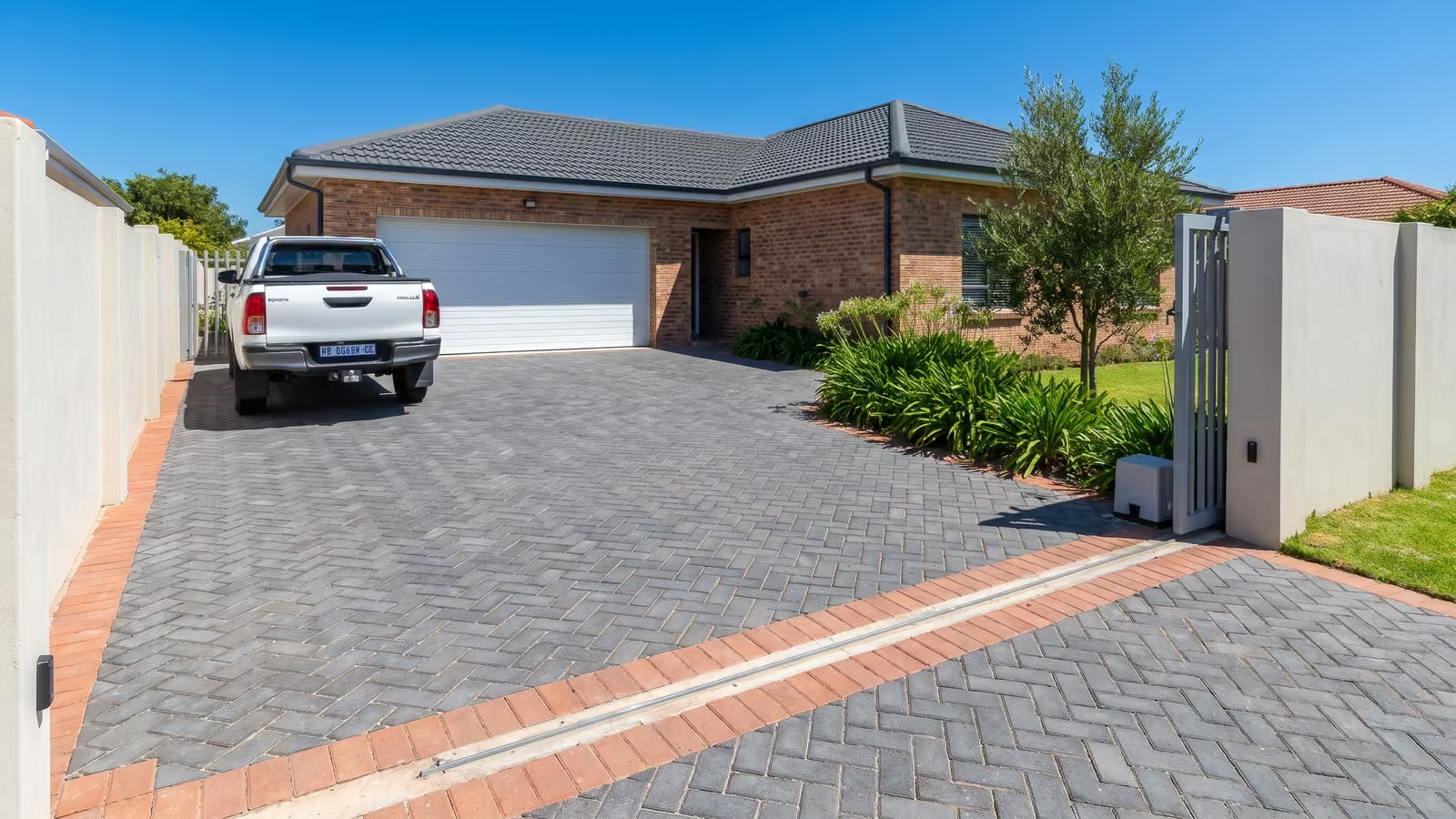
Driveways laid in the pattern the client asks for, with the crossing over the verge built and the permit applied for.
Tar and asphalt
Hot-mix asphalt for driveways and parking areas.
Exposed aggregate
Exposed aggregate concrete, quoted per job.
Cleaning and sealing
Paving cleaning and sealing, with sealing quoted per job.
What the standards put under the bricks
The Concrete Manufacturers Association (CMA) says most pavement failures come from water getting into the layers under the blocks.
The City of Cape Town publishes the layers it wants under a residential paver crossing over the verge. Its Table 6-1 lists 60 or 80 mm interlocking concrete pavers on a 25 mm bed of loose sand. Under that sits a 150 mm cement-stabilised C4 base on 150 mm of G7 subgrade. The same table adds a 150 mm sand layer where clay is found, preferably wrapped in geofabric.
The CMA's guides add these points.
- The CMA says a minimum fall of 2% in any direction is generally required.
- Joints between pavers stay between 2 mm and 6 mm wide, under SANS 1200 MJ.
- The CMA says kerbs, exposed or hidden, are essential to stop paving from spreading and losing interlock.
- The CMA's laying guide beds the blocks with at least two passes of a plate compactor, then vibrates the joint sand in.
- SANS 1200 MJ, quoted by the CMA, keeps vehicles off new paving until every joint is filled.
Pool surrounds, patios and garden paths
Paving around a pool and in the garden carries feet rather than cars. The CMA says 50 to 60 mm blocks are generally adequate for domestic use. Bosun's pool paving guide says the right paver offers slip resistance and stays cool underfoot. The pool paving ideas guide covers copings and finishes.
How a paving job runs
- Request. Send the job type, the rough size and the suburb through the form, or call or WhatsApp 062 397 4233.
- Written quote. Paving for Africa gives a written, itemised quote per m², with the base, the paver, edging, removal and the verge crossing set out line by line.
- The verge. Paving for Africa builds the verge crossing and applies for the permit.
- After laying. The CMA advises re-sanding and re-vibrating after six months or after the first heavy rain.
Permission for the verge and the driveway crossing
In the City of Cape Town, the RIM Wayleave Standards place a new or altered driveway crossing, and hardening or surfacing of the road verge, in the "no wayleave required" column of Table 1. That work falls under a Miscellaneous Permit instead, applied for at the relevant Roads Infrastructure Management district office. The standards say no work may start without a signed permit.
Cape Town areas with their own paving page
Paving for Africa serves Cape Town and surrounds. Ten areas have their own page, and the areas page groups them by municipality.
Choosing a paver and a pattern
Concrete and clay are the two block paving surfaces the City allows on its roads. The CMA's design guide says herringbone gives the best resistance to sideways creep and rutting. Paving for Africa lays whichever pattern the client asks for. The types of paving guide compares materials, and paving patterns compares bonds.
Paving questions from Cape Town homeowners
How much does paving cost per m² in Cape Town?
Cobble paving averages about R580 per m² in Cape Town, the mean of three independent Cape Town installers. Cement paving supplied and laid is quoted per job, as fewer than three Cape Town installers publish an independent price.
What thickness of paver does a home driveway need?
The CMA says 50 to 60 mm blocks are generally adequate for domestic use and recommends 80 mm for industrial use. The City of Cape Town specifies 60 or 80 mm interlocking pavers for a residential crossing.
When can I drive on new paving?
Only once every joint has been filled with sand. SANS 1200 MJ, quoted by the CMA, bars vehicles until all joints are filled.
Do I need permission to pave my verge in Cape Town?
Yes. A new or altered driveway crossing, or paving the verge, needs a City of Cape Town Miscellaneous Permit rather than a wayleave, and no work may start without the signed permit.
Should new paving be sealed?
No, not as a rule. The CMA does not recommend surface sealants on concrete block paving, because of the cost, wear and regular upkeep.