
Driveway Paving in Cape Town
Driveway paving in Cape Town is quoted per job, as fewer than three Cape Town installers publish a price. Paving for Africa lays driveways in the pattern the client chooses, and builds the crossing over the verge and applies for the permit.
- Quoted per job
- 60 or 80 mm pavers on the City's residential crossing
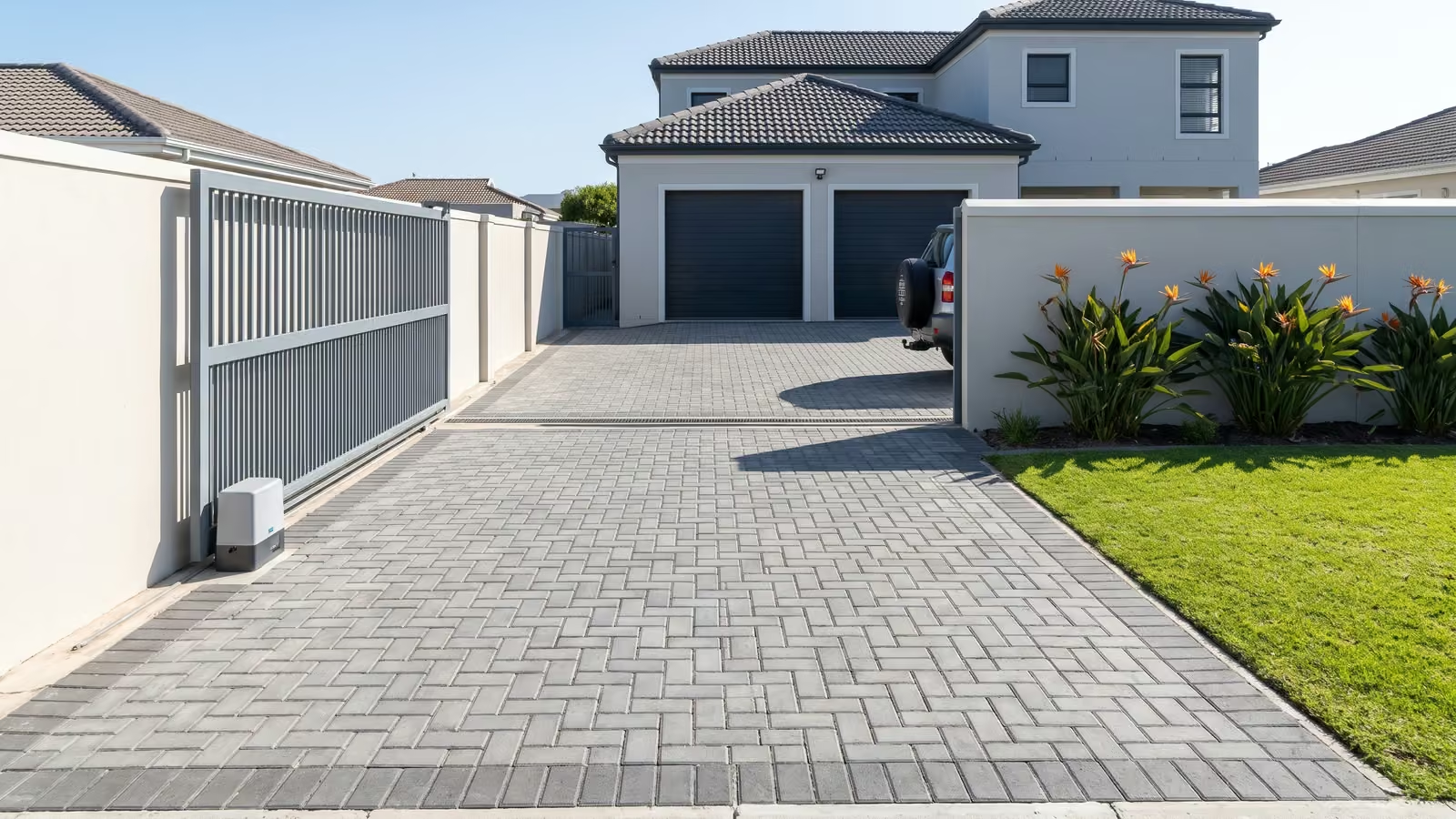
- Herringbone: the CMA's best pattern against creep and rutting
- Verge crossing under a City Miscellaneous Permit
Get a driveway quote
Choose the job, the size and the area, and leave a number. Paving for Africa phones or WhatsApps you back.
Or call / WhatsApp 062 397 4233 · open WhatsApp
Which paver for a Cape Town driveway
The table sets out the CMA's guidance on paver thickness and pattern, and the two SANS 1058 strength classes.
| Choice | Home driveway | Heavier traffic |
|---|---|---|
| Thickness | 50 to 60 mm (generally adequate for domestic use, says the CMA) | 80 mm (the CMA's recommendation for industrial use) |
| Strength class | SANS 1058 class 30/2.0 or 40/2.6 | Class 40/2.6 (the CMA does not recommend 30/2.0 for heavy traffic) |
| Pattern | Herringbone | Herringbone |
The CMA's design guide says herringbone gives the best resistance to both sideways creep and rutting. Its introduction guide adds that herringbone performs better under traffic than stretcher bond or basketweave. Type S-A blocks, which interlock on all faces, can generally be laid in herringbone running with the length or the width of the driveway.
Driveway paving in Cape Town starts with the base
For a home's light-duty crossing over the verge in concrete pavers, the City of Cape Town specifies a 150 mm C4 base on 150 mm of G7 subgrade, with pavers on a 25 mm uncompacted sand bed. The City's table gives an overall excavation depth of 385 to 405 mm for that option. Where clay is found, the same table adds a 150 mm sand layer.
The CMA says natural ground will normally provide sufficient strength for domestic driveways, subject to conditions. Fill must be compacted, the ground must not be subject to saturation or ponding, and the surface must be free from weeds or tree roots and finished smooth.
Bedding sand is screeded about 25 mm loose and compacts to roughly 20 mm. The CMA says it should not be used as a levelling course to fill voids in the subbase, because this leads to settlement. The CMA says never to add cement to bedding or jointing sand, and not to lay plastic sheeting under the sand, since it stops water draining and does not stop weeds.
The garage threshold and where the water goes
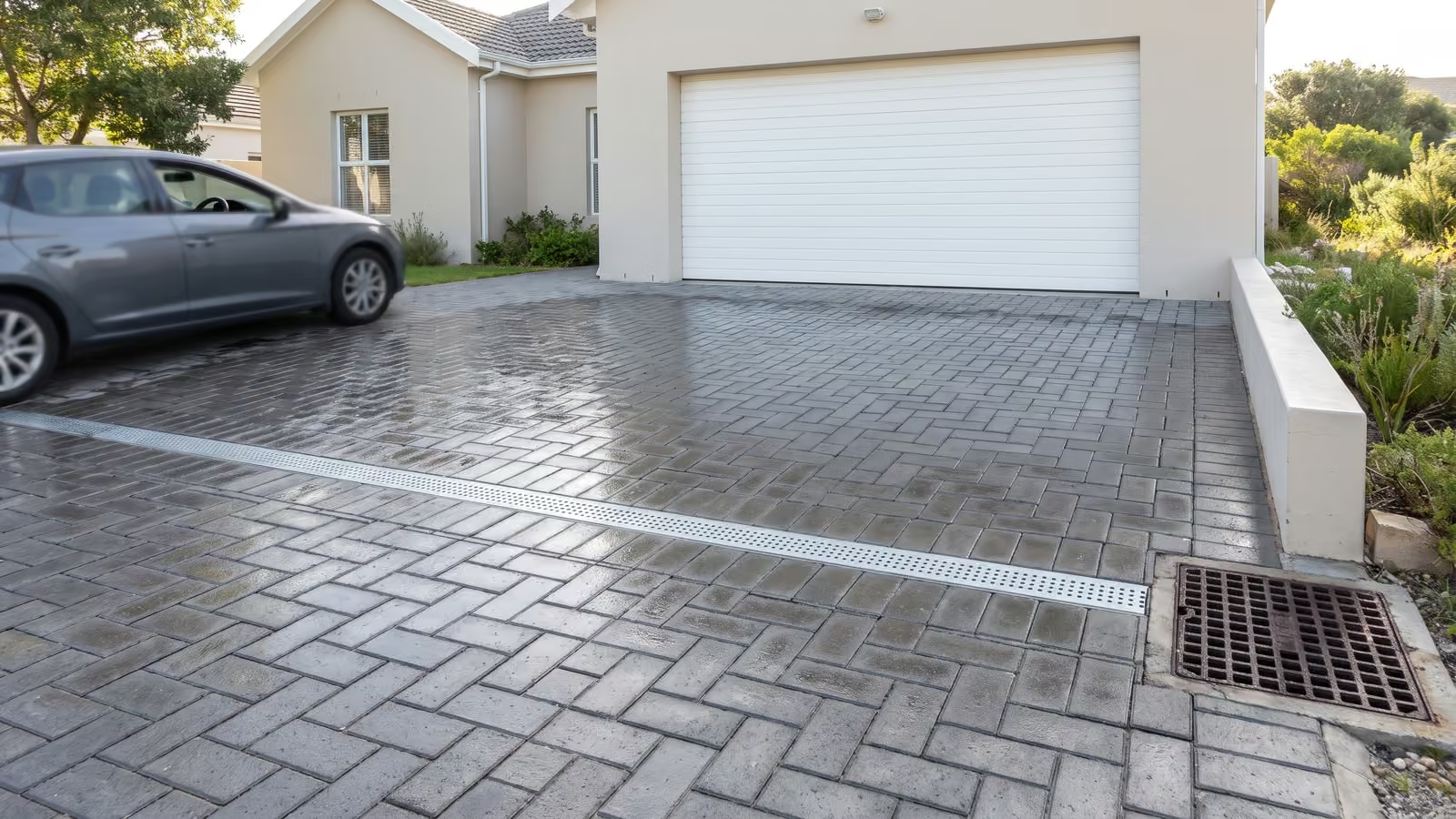
The CMA's homeowner guide uses a minimum slope of 1 in 50 in one direction and 1 in 100 in the other, with paving sloped away from the garage floor level. The CMA says paving should be laid 5 to 10 mm higher than stormwater structures or channels.
The City's Stormwater By-law lets the City direct an owner to keep stormwater on the property, or to pipe it to a place the City chooses at the owner's cost. The driveway drainage guide goes through the options.
Sloping driveways
The CMA's note on steep slopes says that, if uncontained, traffic forces on a slope cause blocks to creep downhill. The CMA recommends stabilising joint sand only on slopes steeper than 1 in 20, around downpipes and along roof overhangs with no gutters. For roads steeper than 12% it recommends an anchor beam at the lower end of the paving to prevent creep, and between 8% and 12% it leaves the choice to the engineer.
The crossing over the verge
The City of Cape Town defines a carriageway crossing as the driveway section built where vehicles cross the footway or verge to enter private property. Its standards set the details.
- A barrier kerb is dropped to leave a 40 mm kerb face, measured from the channel invert.
- For a property higher than the road, with barrier kerbs and a surfaced footway on a wide verge, the crossing rises no more than 2% from the back of the kerb to the back of the footway.
- In that case the ramp from the back of the footway to the erf boundary may be up to 8% where pedestrians use it, or 10% where only vehicles do.
- Mountable kerbs, narrow verges and properties lower than the road have their own profiles in the City's standards.
- The change in grade at either end of the crossing may not exceed 17%, which the City says keeps most vehicles from scraping; designers check undercarriage clearance as well.
- A crossing for a non-industrial erf sits at least 10 m from an intersection, measured from the prolongation of the street boundaries.
This work needs a City Miscellaneous Permit, not a wayleave, and no work may start until the permit is signed.
Permeable paving for a driveway
Permeable block paving lets rain soak through wider joints filled with angular aggregate instead of sand. The CMA gives a percolation rate of 4000 mm an hour through the joints of newly laid permeable paving, into a sub-base that stores the water. It comes as full infiltration, partial infiltration with outlet pipes, or a lined tank with no infiltration.
When you can drive on a new paved driveway
For conventional paving with sand-filled joints, cars stay off until every joint has been filled with sand. After laying, the blocks are bedded with at least two passes of a plate compactor, then the joint sand is vibrated in with two or three more. The CMA advises re-sanding and re-vibrating after six months or after the first heavy rain.
Tar or exposed aggregate instead
A driveway can be surfaced in asphalt or concrete as well. The City's wayleave standards list asphalt, segmented block paving and concrete as approved materials for driveway crossings. Tar driveways and exposed aggregate concrete are quoted per job, like paved driveways. For layout ideas see driveway ideas. Paving for Africa lays all three; see paving contractors in Cape Town for the full range.
Driveway paving questions
How much does a paved driveway cost in Cape Town?
Driveway paving is quoted per job, as fewer than three Cape Town installers publish a price. For comparison, cobble paving averages about R580 per m² across three Cape Town installers.
Is 60 mm paving strong enough for a driveway?
Yes, for a home driveway. The CMA says 50 to 60 mm blocks are generally adequate for domestic use and recommends 80 mm for industrial use.
Which paving pattern is best for a driveway?
Herringbone. The CMA says it gives the best resistance to sideways creep and rutting. It performs better under traffic than stretcher bond or basketweave.
Why does my paved driveway sink in two tracks?
The CMA names inadequate subbase or subgrade, subsoil water, overloading and a bedding sand layer that is too thick as causes of settlement. It says most pavement failures come from water getting into the layers under the blocks.
Do I need a permit for a new driveway crossing?
Yes. In the City of Cape Town that is a Miscellaneous Permit from the Roads Infrastructure Management district office. It replaces a wayleave for this kind of work.