
Paving Pattern Types: Herringbone, Stretcher Bond and Basket Weave
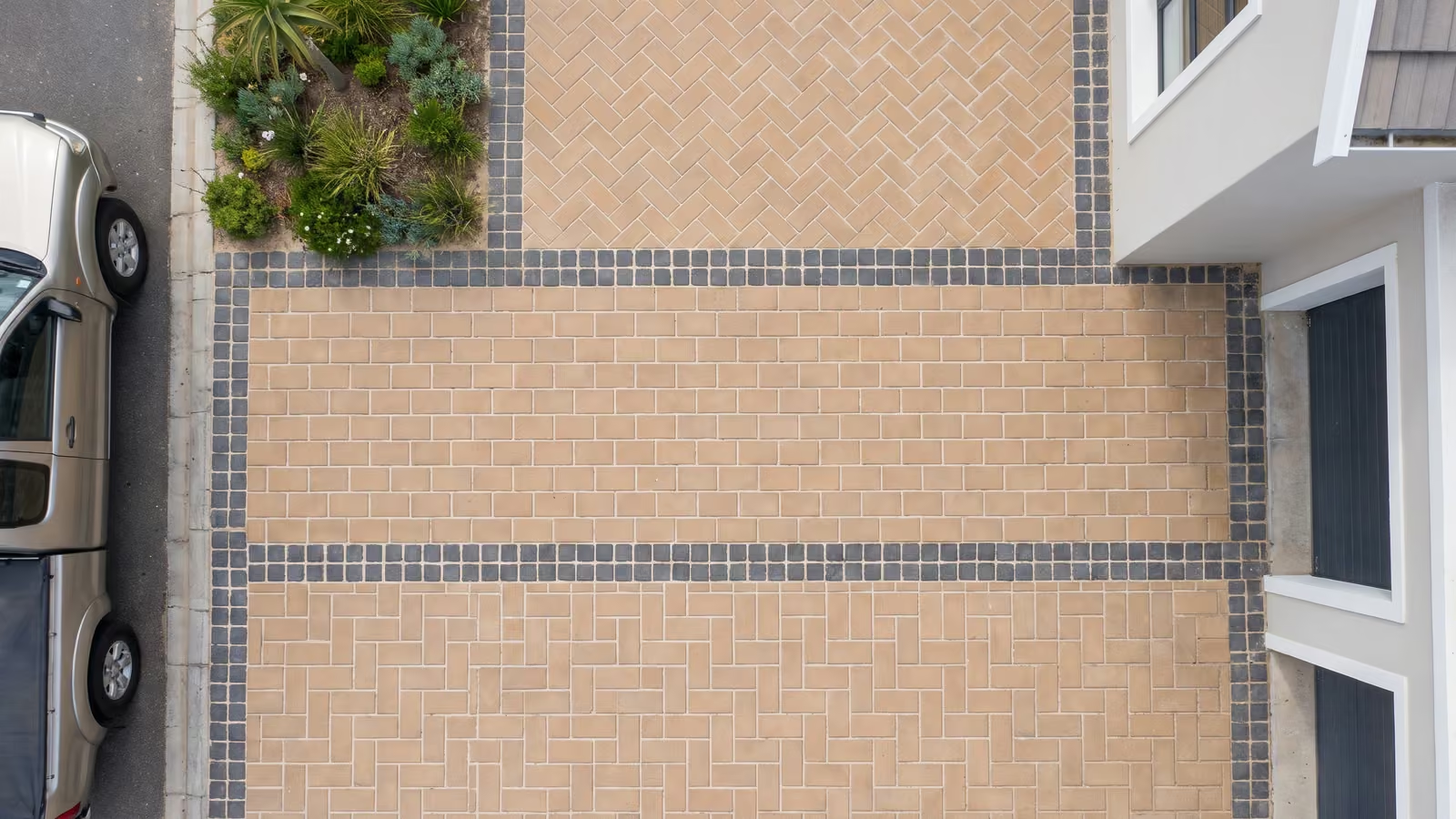
For traditional oblong or interlocking blocks, the Concrete Manufacturers Association (CMA) sets out three basic paving pattern types: herringbone, stretcher bond and basket weave. The CMA's Book 1 says pavements laid in herringbone perform better under traffic loads than stretcher bond or basket weave. The Clay Brick Association recommends herringbone, at 45 or 90 degrees, for wheeled traffic areas. Bosun says square bond and basket weave are not ideal for vehicular traffic.
- Herringbone for concrete and clay block paving under vehicles (CMA, Clay Brick Association)
- 45 or 90 degree herringbone: no apparent structural preference either way (Clay Brick Association)
- Cut pieces under about 25% of a paver not recommended (CMA)
Get a paving quote
Choose the job, the size and the area, and leave a number. Paving for Africa phones or WhatsApps you back.
Or call / WhatsApp 062 397 4233 · open WhatsApp
Paving pattern types at a glance
The table sets each pattern against the guidance from the CMA, the Clay Brick Association and Bosun.
| Pattern | Under cars | Notes |
|---|---|---|
| Herringbone, 90 degree | Recommended for wheeled traffic | Can be gauged on the paver's width alone, whatever its length |
| Herringbone, 45 degree | Recommended for wheeled traffic | The Clay Brick Association's pick for flexible clay paving on sloping driveways |
| Stretcher bond | Performs less well under traffic loads than herringbone (CMA Book 1) | Rows of pavers with the joints staggered |
| Basket weave | Pedestrian areas | Easiest to control when the paver length is twice its width plus the joint |
| Square (stack) bond | Not ideal for vehicles | Bosun's reason: avoid long unbroken joints running with the traffic |
Which paving pattern is the strongest?
Herringbone. The CMA's design manual, Book 2, rates herringbone best at resisting deformation, horizontal and vertical, and says it is generally recommended for industrial pavements. Its specification, Book 3, says the pattern lines are set by the project specification or drawings, as agreed with the engineer. Where they are not, units go down in herringbone if the block shape permits. Units that cannot be laid that way are turned so their long axis crosses the line of traffic at right angles.
The reason is the joints. Bosun warns against long, unbroken joints that run the same way as vehicles travel. Bosun says herringbone provides the best interlock, because it can take traffic from several directions and spreads loads better.
For flexible clay paving on sloping driveways, the Clay Brick Association goes further. Its section on those driveways asks for pavers in 45 degree herringbone, and does not recommend other patterns for vehicles there.
45 or 90 degree herringbone
The Clay Brick Association recommends herringbone at both 45 and 90 degrees for wheeled traffic. In its discussion of horizontal interlock, it says there seems to be no structural preference between the two directions. Its sloping-driveway section, written for flexible clay paving, still names 45 degrees. A diagonal layout meets straight edges at an angle, so the edge pavers are cut.
The CMA's homeowner guide says to add 10% more for cutting and wastage, and the same guide says to maintain 3 mm joints while marking and splitting the cut pieces.
Edges, cuts and borders
A lot of what makes a pattern look tidy happens at the edge. The CMA's Book 3 does not recommend cut pieces under about 25% of a full unit, because traffic can knock such small pieces loose. Where herringbone meets an edge restraint at an angle, it recommends turning the pattern to run along the edge, which removes the need to cut blocks lengthways.
The Clay Brick Association recommends a minimum cut piece of one-third of the paver's area for a crossways cut, or one-quarter for a diagonal cut. The CMA's homeowner guide double-cuts pavers to avoid narrow slivers: two pavers cut across their width instead of one cut along its length. It adds one more rule: do not mix patterns, choose one and stick with it.
Makers show patterns finished with a border. SmartStone shows 45° herringbone with a soldier course border. Revelstone shows its Kent Cobble in square bond with a border, diagonal with a border and herringbone with a border. Bosun says complex laying patterns involve more planning and precise cutting, and should be left to experienced installers.
The paver's shape limits the pattern
Some pavers rule out some patterns. The Clay Brick Association says basketweave is easiest to control when a paver's length equals two widths plus the nominal joint. A 200 x 150 mm paver such as Bosun's Smooth Ethnic is not twice as long as it is wide, so it does not meet those easiest-to-control basketweave proportions. Herringbone is more forgiving: the Clay Brick Association says its gauge can be set from the paver's width alone.
Interlocking (S-A) pavers are a separate case. The City of Cape Town's road specification describes them as interlocking on all sides. Bosun still recommends laying interlockers in herringbone with solid edge restraints like concrete kerbs, for the best possible interlock.
Choosing a pattern for each area
Driveways and parking take herringbone, as the CMA and the Clay Brick Association recommend. The Clay Brick Association says many other decorative patterns can be laid, but limits them to pedestrian areas. That makes them options for paths, patios and pool surrounds, within what the chosen paver's shape allows. A garage apron that cars turn on carries wheeled traffic, even when it sits beside the patio.
Paving for Africa is one of the paving contractors in Cape Town and lays paving rather than selling pavers. A suggested reading order is the paver first, then the pattern: the types of paving guide compares the materials and the paving design ideas guide covers colour blends and borders.
Paving pattern questions
Which paving pattern is the strongest?
Herringbone. The CMA's Book 1 says pavements laid in herringbone perform better under traffic loads than stretcher bond or basket weave. Book 2 rates herringbone best at resisting deformation, horizontal and vertical.
What pattern is best for a driveway?
Herringbone, at 45 or 90 degrees, which the Clay Brick Association recommends for wheeled traffic. For flexible clay paving on a sloping driveway, it asks for 45 degree herringbone.
Is 45 or 90 degree herringbone stronger?
No. The Clay Brick Association says there seems to be no structural preference between the two directions of herringbone. For flexible clay paving on a sloping driveway, it still names 45 degree herringbone.
How much waste should I add for a herringbone pattern?
The CMA's homeowner guide says to add 10% more for cutting and wastage. Its specification, Book 3, does not recommend cut pieces under about 25% of a full unit.
Which laying pattern should I use for a patio?
Herringbone or one of the decorative patterns. Beyond herringbone, the Clay Brick Association says many other decorative patterns can be laid, but limits them to pedestrian areas. It finds basketweave easiest to control when a paver's length equals two widths plus the nominal joint.